SUBSCRIBE ON:
 Spotify
 iTunes
 Google Play
 Stitcher
Introduction To Guest
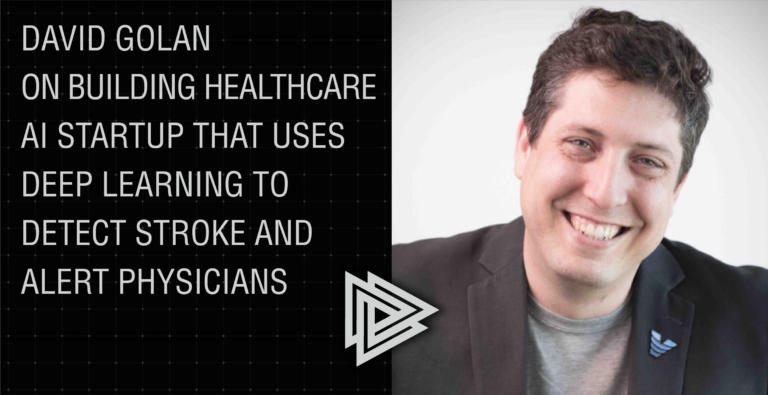
David Golan is a co-founder and the CTO of VIZ.AI, a digital healthcare company harnessing deep learning to analyze medical data and improve clinical workflow. VIZ.AI developed the First ever, FDA-approved, AI-powered triage system for stroke. Prior to founding VIZ.AI, David was a Fulbright postdoctoral scholar at Stanford University, working on leveraging deep learning for the analysis of medical imaging and genetic data. David holds a PhD in Statistics and Machine learning from Tel-Aviv University, and has co authored more than 20 scientific papers, including three publications in the Journal Science.
Coming Up With The Idea
David Golan has been working in the AI, machine learning, and data science space for about 18 years, receiving his PhD in Machine Learning. David was content with his career pathway, and was set to return to Israel from the US to take a faculty position and work in academics. However, it was not until an unexpected event in 2015 where David’s life completely changed. He suffered from a suspected stroke that left David unable to move his arm and leg for a period of time. He was also unable to speak. David experienced first hand the massive gaps and wrong-doings in how inefficiently patients were treated. He knew that moment had changed his life and his career path.
The Call To Action
After David’s health scare, he was introduced to his co-founder and now CEO of VIZ.AI, Dr. Chris Mansi. Chris is a neurosurgeon from the UK who moved to the Stanford business school in California. Chris had numerous cases with surgeries that he performed, all which have gone extremely well, but some of the outcomes unfortunately resulted in the patient’s death. When investigating why, David and Chris realized it was because of workflow delays, chaos and inefficiencies, very similar to the same problems David experienced as a patient. Chris suggested automating this workflow by identifying the patients that need expert care and triage them, which quickly sends them to the care of a highly skilled physician. With Chris’ expertise as a neurosurgeon, and David’s extensive background in machine learning, VIZ.AI was born.
VIZ.AI is now a 100 people company, split equally between the US and Israel. The R & D team is almost entirely in Tel Aviv, while the rest of the operations team is based in the United States.
In order to build a successful product, David had to understand both the medical imaging and the different use cases, identifying the exact problem they were trying to solve, while finding the best solution. At the same time, he and his business partner had to understand the financial side of healthcare and how to build a business model that makes sense. They also had to raise money to start building the products, which consisted of pitching to VCs. In order for VIZ.AI to be successful, David and Chris had to work on connecting with people that could support them with getting data – which is critical to power Artificial Intelligence.
David and his team believe that the world needs accelerated acute care, which can be achieved through Artificial Intelligence. VIZ.AI is built to hit three points known as the triangle. One point is the patient, the main incentive behind VIZ.AI. The second point is the physicians, making their lives easier and better. The third point, which is often missed in the healthcare space, is coming up with a solid business case for the financial operators of the hospitals. This is crucial when starting a business in the healthcare industry.
How VIZ.AI Technology Works
When a patient has a stroke, 70-80% of the time they will go to the nearest hospital, typically a smaller hospital, called a primary stroke center. The smaller hospital can provide first line treatment, but they cannot perform a full blown surgical procedure to remove the clot in the brain, which causes the stroke. Once the decision is made that an actual stroke case is present, the patient is moved onwards from a comprehensive stroke sample to a big hospital that has all of the facilities to operate. This back and forth, inefficient coordination between the two hospitals causes massive delays, especially when making decisions. With each minute delay, 4.2 days of disability life accumulates.
When a patient goes into the scanner, the cloud scan is analyzed by AI, identifying whether or not the patient is suffering from a stroke. AI is used to complete the triage. From there, VIZ.AI immediately notifies the entire chain of command, with the team receiving a loud alert noise on their phones. The team can then open the VIZ App, where they not only receive a notification, but receive images and can chat between colleagues, essentially communicating extremely fast. The physicians also have a call center they can access. This process completely flips the system by eliminating the uphill battle. With the most experienced physicians receiving notification calls, the ER can provide the scans quickly, maximizing the workflow to the fullest. This is a revolutionary feat, changing the way acute care workflow is being managed, while at the same time saving lives.
While the company is called VIZ.AI, David believes his company is more as a workflow company, with both Artificial Intelligence and technology being a big part of what they do. Both AI and tech are just as important and useful when focusing on moving the needle to make patients better. VIZ.AI is successfully up and running in over 400 hospitals in the United States.
Challenges Encountered
One of the biggest challenges encountered by VIZ.AI is to understand the business side of the hospitals, while using do-good technology to help patients. It is crucial to implement the technology while also catering to the needs of the administrators and the financial stakeholders in the hospitals.
Another point David makes is how lucky VIZ.AI was to find extremely collaborative, supportive, frontline physicians who helped bring the vision to life. These physicians are able to provide the team with data, feedback, and expertise. However, there were a few challenges while setting up an impressive data collection network. This, at first, was easy, but then proved to be difficult for hospitals who were all connected to the cloud. With scans finding their way to one cloud based app, issues started to arise with the IT security of the hospitals.
David reiterates that from the get go, when operating in healthcare make sure you have a security-first mindset, along with the certifications and credentials to show for it. Invest a lot of effort in making sure your data and scans are secure.
Pivoting Through COVID-19
When the pandemic hit, VIZ.AI was able to pivot to assist patients in need. David and his colleagues were able to create a modified version of their VIZ App to support COVID-19 teams, notifying physicians on positive or suspected cases. This proved to be extremely helpful and successful, with about 20 hospitals now using VIZ services. VIZ.AI is able to deliver even more value to their users.
Another transition, or pivot, VIZ.AI encountered through COVID-19 was when the sales team stopped traveling. The sales department, which consists of nine people, are all now working from home, saving VIZ.AI a lot of money. Interestingly enough, this change did not slow down VIZ.AI’s sales. This realization has caused David to question the traditional methods of operation.
The Future
Two years from now, VIZ.AI envisions it’s product managing every acute case that comes into the hospital. Five years to ten years from now, the company will not be limited to acute care — there will, in fact, be no limitations. Not only will VIZ.AI be providing Artificial Intelligence to add value, but all of their physicians and hospitals will have a fast app that instantly connects everyone, creating a massive generation leap in terms of working together. At the end of the day, the mission of VIZ.AI is to help patients be seen by the right doctors and receive treatment efficiently and effectively. The company wants to make connections for all diagnoses, while eliminating the variability in the level of care across the world. With an AI powered healthcare operating system, a patient can live in a poor neighborhood but has access to the best physicians, possibly located on the other side of the country. More people will have the opportunity to receive the best level of care, regardless of the socialist disadvantage regions and countries of the world.
Advice For Industry Leaders
David’s advice for industry leaders is to stay open to the challenges you are facing, and get clear on your financial model. Find use cases that are both clinically useful and financially viable. While this feat can be challenging, it is crucial in order to have a successful company. In fact, not having this method in place is what causes most healthcare startups to fail. Make sure to keep your thinking progressive. See how you can harmonize trust with hospitals and/or companies in the healthcare space, especially when it comes to security. This will accelerate healthcare transformation as a whole.
www.viz.ai

About the Host
Ari Yacobi is a data scientist, a teacher and a storyteller who has spent his career at…Read the Bio

Приобретение официального продукта на WB
С какой целью выбирать легальный продукт на WB
Многие люди полагают, что Wildberries — это
только обувь и хозяйственные изделия.
На деле там теперь распространяют
лицензионные приложения для труда
и образования. Ассортимент охватывает
десятки предложений — от специализированного программного обеспечения до деловых сборников.
Популярные продукты в каталоге
WB
Microsoft Office 2024 Professional является главным из известных решений на платформе — полноценный пакет для профессиональной работы.
Кроме того, в разделе находятся Microsoft Office 2023 Professional, Microsoft Office 2025 Professional, Microsoft Office 2026 Professional и Microsoft Office 2020 Professional.
Каждая вариация подходит для конкретных целей и типов лицензирования.
Особого рассмотрения удостоен Adobe Photoshop 2024 Полный комплект — мощный продукт для обработки материалов.
На указанной площадке представлены Adobe Photoshop 2023 Полный комплект, Adobe
Photoshop 2025 Полный комплект и Adobe Photoshop 2026 Полный комплект.
Покупатели оставляют отличные
оценки: активация осуществляется без
задержек, лицензии настоящие.
Техническое лицензионное решение на WB
Проектировщики, трудящиеся в конструировании,
найдут на странице Компас 3D v24 Полный комплект.
Указанный комплекс активно задействуется при строительстве домов и подготовке проектных материалов.
Комплексный сборник охватывает все обязательные компоненты для полноценной проектировки.
Строительство зданий
из панельных конструкций: лицензионные инструменты для
южного региона и Крыма
Сооружение коттеджей из панельных конструкций в Краснодарском Крае и Республике Крым нуждается
в верных вычислений. Проектировщики каркасных строений используют
профессиональное программное обеспечение,
заказанное на площадке. Панельные конструкции дают строить в
сжатые сроки, поэтому правильная документация оказывается
главной элементом дела.
Как купить лицензионное решение на Валбериз
Схема заказа прост: заходишь на
сайт, набираешь наименование пакета — например, Microsoft Office 2024 Professional или Adobe Photoshop 2025 Полный комплект — и оцениваешь позиции.
Стоит смотреть рецензии и уточнять
репутацию продавца.
Проверяй рейтинг продавца перед заказом
Анализируй комментарии о указанной модификации инструмента
Смотри, что за вид доступа предусмотрен в
пакет
Храни квитанции и скриншоты диалога с поставщиком
wb становится настоящей опцией
фирменным точкам продаж для тех,
кто ищет лицензионный пакет
по нормальной цене.