SUBSCRIBE ON:
 Spotify
 iTunes
 Google Play
 Stitcher
Introduction to Guest
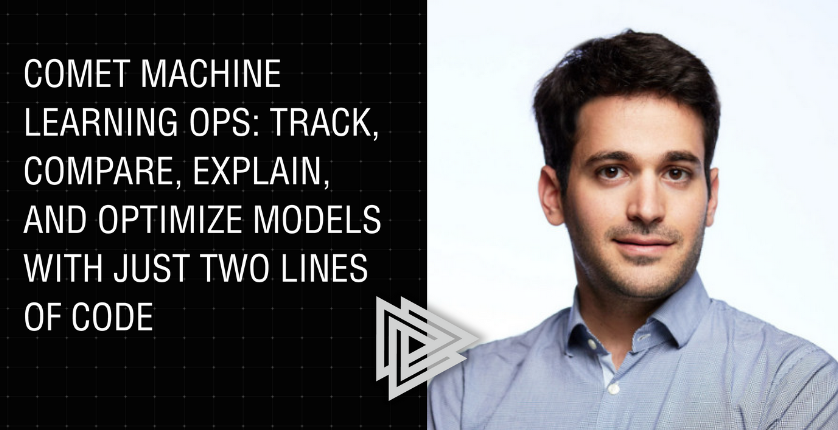
Gideon Mendels is the CEO and co-founder of Comet, a leading provider of machine learning operations solutions that accelerate getting machine learning models into production. Before Comet Gideon founded GroupWize where they trained and deployed over 50 Natural Language Processing models on 15 different languages. His journey with NLP and Speech Recognition models began at Columbia University and Google where he worked on hate speech and deception detection.
Gideon started his career 15 years ago as a software engineer. He soon enrolled in grad school at Columbia and became more intrigued with machine learning, in particular speech recognition. Gideon built a system that was able to collect data, but it was tricky to identify which language it was in. This started his journey of learning natural language processing and language identification. Gideon stumbled upon a problem that was hard to solve with traditional software, and built his first model which was a language identifier
Gideon and his co-founder decided to start a fun side project building an app, and began by collecting data from WhatsApp, Viber, and GroupMe (for example). Through analyzing their findings, they were able to provide interesting metrics. Once released, the app blew up very quickly, hitting 80k users in the first week organically. Gideon knew he found his knack.
Gideon soon started a job at Google, working on hate speech detection on YouTube comments. He brought a lot of experience with document classification, which is essentially the technical term for hate speech detection and was able to improve the production of his team. This was a huge learning experience and time of growth for Gideon.
Coming Up with The Idea
Gideon and his team saw inefficiencies in how the operations around machine learning and data scientists were working in a very old-fashioned way. In these discoveries, they decided to interview over 150 data scientists, asking them about their workflow – How do they do things? How is it tracked? Etc. After this was done, Gideon created two similar products with slightly different variations. Unsure which product was best to go to market, Gideon decided to test both. He and his team bought two domains, built two landing pages, and then drove traffic to the landing pages. From the tracking, he realized ML was the better variation, which turned out to be what Comet is today. Basically, they tracked mock-ups of essentially a very, very early version of Comet.
Testing the Product & Validating the Market
Comet did plenty of market research, as mentioned above. What existed back then were companies and startups trying to solve all the problems in the machine learning workflow. Experimentation, management, model management, orchestration, deployment, monitoring, etc. Comet looked at these companies thinking the scope was way too large for one software company to build. So, Comet decided to do only one thing, and this one thing will be done better than anybody else. This was Comet’s approach.
Comet did talk to many potential clients through introductions, but the focus was a grassroots approach. After a week of launching the product, Comet received emails from data scientists and machine learning engineers working with big companies, loving what Comet had to offer. 90% of Comet’s enterprise customers started as community users.
Comet is a machine learning platform. It could easily be self-hosted by the customer or cloud base. Through working with data scientists and data science teams, the platform allows them to track, compare, explain, and optimize their experiments and models. The product solves problems around reproducibility and being able to help teams get to production faster with a successful model.
Comet now supports some of the biggest and best machine learning teams in the world within the healthcare, tech, media, and finance space. Gideon and his teamwork with Google, Ancestry, the National Institute of Health, to name a few, where they use Comet as their main development platform to build AI models.
One of the biggest challenges was finding the product market fit. While many other companies are doing similar things, Comet is really growing with the market, shifting, and changing by the day, so they are not replacing any legacy systems. From the product market fit perspective, Comet wants to be able to build a product that people are happy about and willing to pay money for. But one must think ahead, for the market is shifting all the time. And if you solve a pain point today, then that pain point is not going to exist in a year, because some of the other market dynamics are changing. This is super tricky. Discipline is key.
Future Endeavors
Comet thrives to be the de facto operating system for machine learning within enterprises while helping their customers bring business value with Artificial Intelligence. The company is very much focused on business-driven missionary teams rather than grad students and centers of excellence.
Another way to think about the future is when you walk in a room of software engineers, there’s usually a TV showing your build system and another TV showing your servers in production. Comet’s vision is in the next few years to have another TV showing their experiments and models. This will all be driven by content.
Advice for Aspiring Entrepreneurs
If you have a few different approaches and you do not know which model will work the best, see how you can try and model something quickly to see which product works the best. Building a successful company also comes down to the people. Comet hired people slowly, to really make sure the best suited candidates joined the team. Once you build that core team, you can start accelerating very fast. Do not compromise the quality of the people that you bring onto your team because who you hire will make all the difference.
Home page

About the Host
Ari Yacobi is a data scientist, a teacher and a storyteller who has spent his career at…Read the Bio
