
SUBSCRIBE ON:
 Spotify
 iTunes
 Google Play
 Stitcher
Introduction To Guest
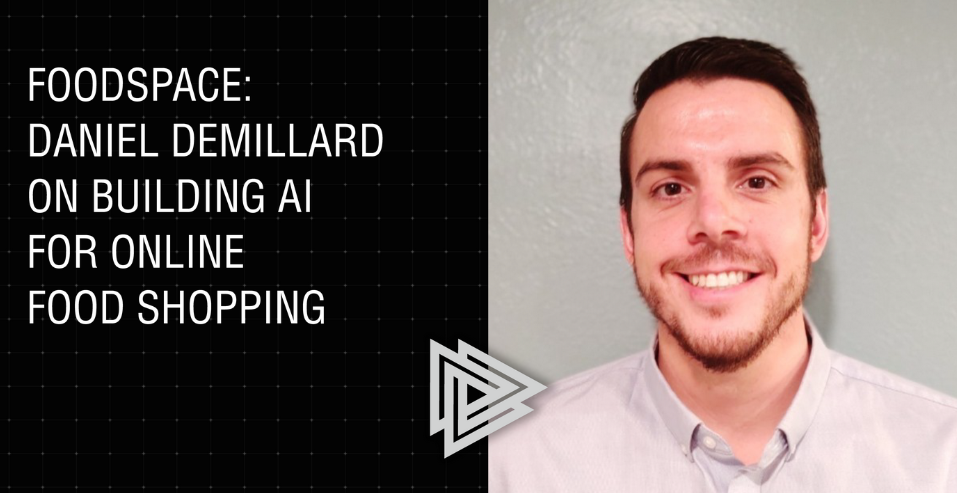
Daniel DeMillard is the Chief Technology Officer of Foodspace, an AI company that helps eCommerce teams increase online sales and brand loyalty by building underlying product data foundations. Foodspace uses vision AI to derive scanned product data into shopper-centric attributes needed for online grocery discovery.
Daniel uses his background in math, along with his spirit of learning, to explore the depths of possibilities of computer vision, natural language processing, and machine learning. Together with his team at Foodspace, they are focused on creating products to improve people’s lives. Previously, Daniel worked as a Data Scientist at IBM Watson and an AI Architect at Zvelo. He graduated from the University of Wyoming with a degree in MS Economics and Finance.
About the Company
Many people began purchasing groceries online to be delivered, especially during the pandemic. Daniel explains that you really need that information digitized on the e-commerce website. What Foodspace found is a lot of product companies do not have that completed or it’s out of date, or even inaccurate. So, the solution that Foodspace provides is they take images from brands or retailers, upload them to their portal or use Dropbox, and then they take those images and extract the structured information such as: nutrition ingredients, net weight, brand name, product name, certification claims, whether it’s non-GMO or gluten free, certified, or vegan certified, etc. Foodspace will then use the date to build some enrichments on it, listing what allergens are present in the ingredients, the dietary information, whether it is vegan, vegetarian, pescatarian, etc. and then all the information is sent back to the brand so they can become more discoverable on platforms that support those filters. Foodspace is also improving the user experience. For example, if you are looking for low sodium or low sugar, you can easily find the products you are looking for online.
Testing the Product
Initially, Foodspace thought that their customers would be grocery stores. But since they’re slower to innovate, this was not the case. Before the pandemic, around 95% of sales still happened in a store, and only 5% were online. After the pandemic, that has jumped to 15-25% of online sales. However, this jump was not enough. There was still a very large portion of purchase service being made in the store. To some extent, the retailers must be very forward thinking with this technology and the value of getting everything digitized and accurate.
Whereas the brands specifically easily understand the value of providing high quality information to their customers.
With that being discovered, Foodspace’s pivoted to have brands as their primary customers. Foodspace digitizes all their information for them. Foodspace realized that many of these brands’ product labeling is all managed through a third-party agency. Brands are also updating recipes and product information on the package per year, which can take non-AI solutions two to six months to get the data labeled. Foodspace can complete the same exact task with a turnaround time of a day or two.
Another big add is that Foodspace has their own internal data model and can map their model to each one of the retailers. Foodspace will extract all the information from the images, digitize it, and then map it to whatever format a retailer wants. Foodspace will even put it all into an Excel spreadsheet. All the brands must do is copy and paste the information that Foodspace cannot extract from the images (such as price) that’s usually not included in the product image.
Validating The Market & Learnings
Foodspace started looking at retailers first. They really struggled because they were getting a lot of positive feedback, and there was a lot of interest, but little sales. Foodspace discovered that on walmart.com between 40-60% of products had at least one product, or had at least one data error in the ingredients, or the nutrition. There is a massive data accuracy problem. When Daniel and his team talked to large retailers, the digital market was only a small percentage of sales. Foodspace had large contracts with big retailers, but it was difficult to close the deal. This challenge pivoted the company to speaking with brands.
The brands were very excited to move forward with the Foodspace pilot because they did not have any data yet. The contracts with brands are smaller, so it’s a lot easier to onboard new clients for Foodspace.
Working with brands was a big aha moment for Foodspace, especially when they began gaining positive feedback from the brands. Foodspace realized that this was the right direction to go. They also started to build relationships with grocery delivery companies like Instacart and Ship.
With online grocery companies being digital first, the only interaction with the food products is through the app or website. These companies care a lot about the digital assets and making sure the products are searchable. They want to make sure the customer experience is great.
The idea of targeting brands to start with was not obvious to Foodspace. There was a lot of trial and error and networking.
Business Model
When a brand comes to Foodspace, they have an upfront digitization fee. So, they can then download it in a CSV or JSON. Then Foodspace will charge each retailer for data mappings. An additional service Foodspace provides is monitoring. They will specifically scrape those websites and monitor a brand’s product to make sure that it is up to date and accurate on the website. There is no change for each retailer that they’re syndicating to or sending information over to, but there is a monitoring fee if the brand would like the additional peace of mind.
Challenges Encountered
Daniel and his team are obsessed with accuracy. One major problem that they have faced with their OCR models is adding every single comma that is present. This is tedious because they can be small and a little harder to notice on scar models. But these commas are super important to separate what the individual ingredients are because they can span multiple words. This can take a lot of time.
At a high level, there are multiple small challenges. For example, lighting changes in the angle of the pictures, changes in the surface material, changes in background color gradient, changes in container tape, etc. Every single problem encountered requires a different technological solution. They must be solved one by one. This takes a lot of work and time.
Another challenge is adding in allergies, or even vegan food. “Vegan” can have a different meaning for each person.
Future Endeavors
Foodspace believes that the trend for buying your groceries online is going to increase. More people will opt for the experience of either having their groceries delivered to their doorstep or driving to the store to have their groceries loaded into the car.
Foodspace is looking to expand into new markets like Europe and Asia, as well as adding new product categories – pets, alcohol, health, and beauty. Their goal is to really expand the product offering to include more retail brands. They would also like to see more of their data integrated into a smart fridge where you can order directly from your smart fridge. Another cool idea that Foodspace would like to accomplish is automatically setting your oven to your microwave to the correct amount just by using your smartphone to scan your product.
Advice For Aspiring Entrepreneurs
Start with something solvable, tractable, and concrete. Use AI to target problems with a focus of solving one thing. Daniel also recommends having an expert who can help you. There will be a lot of nuances where you won’t know where things are breaking, or why they’re breaking, if you do not have the expertise.
Daniel’s final piece of advice is to build out MVPs. Build out the smallest thing possible and then make it better. Oftentimes the MVP is asking a question, not developing a product or a demo. Talk to the people in your industry. Some people are better networkers than others. Hopefully you can either develop that skill set yourself or find a partner that can do that for you. Talk to as many people in your industry as possible before you build a fancy technological solution.
https://seekartech.com/

About the Host
Ari Yacobi is a data scientist, a teacher and a storyteller who has spent his career at…Read the Bio

What’s up it’s me, I am also visiting this website regularly, this web page is
really nice and the viewers are actually sharing fastidious thoughts.