
SUBSCRIBE ON:
 Spotify
 iTunes
 Google Play
 Stitcher
Introduction To Guest
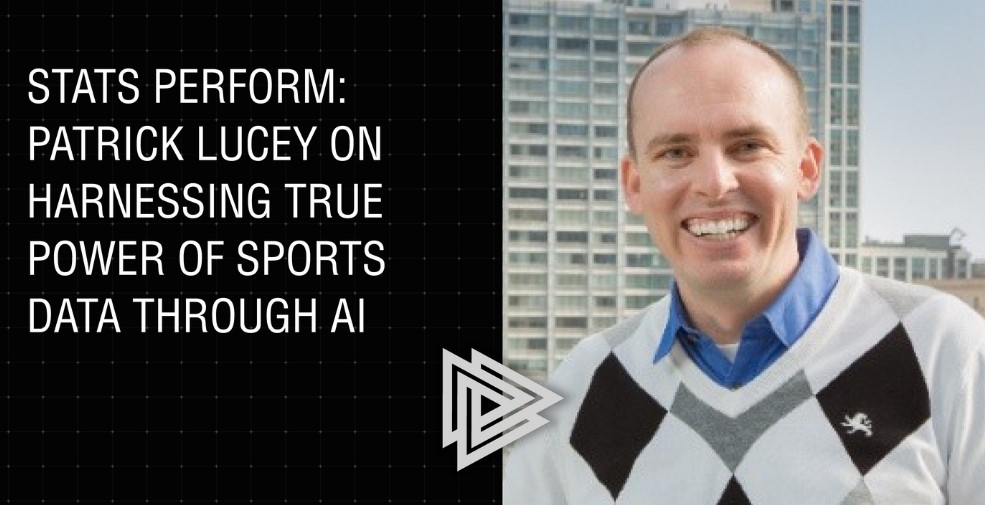
Patrick Lucey is the Chief Scientist at Stats Perform, maximizing the value of the company’s 35+ years of sports data. Previously, he was at Disney Research, where he researched automatic sports broadcasting using large amounts of spatiotemporal tracking data. Prior to that, Patrick was a Postdoctoral Researcher at the Robotics Institute at Carnegie Mellon University/Department of Psychology at University of Pittsburgh conducting research on automatic facial expression recognition. He was a co-author of the best paper at the 2016 MIT Sloan Sports Analytics Conference and in 2017 and 2018 was co-author of best-paper runner-up at the same conference. Additionally, he’s won best paper awards at INTERSPEECH and WACV international conferences.
Patrick is a sports lover who was born in Australia. Growing up, he played almost every sport you could participate in – soccer, cricket, tennis, golf, rugby, you name it. Patrick has always loved numbers and following statistics in sports. During his time growing up in Australia, Patrick played semi-pro soccer while completing his electrical engineering undergraduate, and later his PhD. After he finished his PhD, which was in audio speech recognition, he began analyzing visual and audio data to help improve speech intelligibility and speech prediction. However, Patrick’s passion was in sports.
Patrick was soon lucky enough to obtain a position at CMU, working on analyzing facial expressions, which then led him to work at Disney research Pittsburgh. At Disney, owned by ESPN, the team was working on producing an automatic sports podcast. At this time, sports started to be consumed via streaming, and Patrick was able to track this data, publish papers, which then led him to start his own AI group. With 40 years worth of data at his hands, Patrick and his team became the pioneers in computer vision tracking.
Stats Perform
Stats Perform is a B2B company. The markets they serve are team performance and media/tech. Stats Perform works with the biggest companies around the world. For example, when you check a soccer score in Google, that data comes from Stats Perform. If you ask any sports question to Siri (Apple), the sports data is from Stats Perform. The same with Alexa (Amazon). Even all sports books use the data from Stats Perform. The company has their live Moneyball feed where they have the fastest and best data for in play betting, especially in soccer. Also, the opt out is also part of Stats Perform. Whenever you check any media or follow NBC coverage, data is provided by Stats Perform. Billions of people touch this data every single day. Stats Perform is truly the DNA of sports.
Patrick’s path to Stats Perform
Through Disney research, Patrick was able to work on a lot of great papers. He iterates that to do anything in Artificial Intelligence you must have big sources of data. And now, most of the problems in the industry stem from having to go to places which have the data. Stats Perform has been around since 1981 – which got started through Bill James, James wanted more sports data back in the 80s, which soon spun off stats while providing data across all different sports for a long period of time. However, even though James’ company inherited all this data, they were not utilizing it. James and his team needed someone to set up a data science group or an AI group. Based off of Patrick’s work, he was asked by Stats Perform to join the team and start an AI group. Since starting the AI group at Stats Perform, the company has grown from just Patrick to now 50 people in the AI innovation team. This includes data scientists, computer vision engineers, as well as machine learning engineers. While Patrick was not one of the founders of the company, he did start the AI group on his own in 2015.
Using AI to Harness the Power of Sports Data
There are a couple of ways that Stats Perform uses AI to tell stories. The first is by using computer vision to generate more data. Through having cameras in venues, Stats Perform has been the pioneers in player tracking data over the past ten years. Through the cameras they were able to track players at a very high frame rate. So, a lot of the next generation statistics that you’ve seen in terms of player tracking, basketball, and soccer, initially come from Stats Perform. The company has also embarked on creating more tracking data from broadcasting. With a partnership with Orlando Magic, Stats Perform can collect tracking data from broadcasts, which enables them to go back in time and collect historical footage. By tracking games ten years ago, they can enable teams to come up with recruitment models to predict future performances of college players in the NBA. Stats Perform can create and generate more granular data to tell better stories and make better predictions.
Another aspect of using AI is Stats Perform is they can do a Smart Lookup to generate insights. Just based on the structured data that they have; the team can give natural language insights into what’s happened in sports. This can also be converted into many languages. Stats Perform also has smart ratings where they can tell you when something interesting occurs, or when a moment is very important. Stats Perform has live probability models and season simulation models which can give you the impact of a certain event.
Challenges Encountered on the Path
Patrick and his team have experienced quite a few challenges, starting with getting the data in a form, which is utilized for AI capabilities – building the whole infrastructure and pipeline and getting the team set up. It is one thing to possess the data, it’s another thing to get it in the form where you can put it in for modeling purposes. It’s about leaning into being data centric instead of being model centric. Patrick states if you do not have differentiated data when building a new product, you shouldn’t proceed. This was one of Patrick’s key learnings.
Dealing with building AI models or building AI products is tricky. You need to be always ready for anything. Sometimes Stats Perform has to simplify or make the system more robust before focusing on the prediction accuracy, but you also need reliability. And again, adhering to and addressing all of the edge cases.
Future Endeavors
Stats Pefrom is on a journey to scale out data collection. Their goal is to digitize every video, and to get tracking data from every video that has ever been played, starting with basketball and soccer. Or going back and getting tracking data to get more detailed information. Even though the data exists in terms of videos, it needs to be in a digitized form. The first hurdle is scaling this out.
The next endeavor is being able to create live consumable AI, to make live predictions. This opens the optionality of doing live assisted coaching, providing live insights to people at home, or gamification.
And third, Stats Perform’s additional goal is to lean into reinforcement learning. This includes being able to forecast how a player is going to play long term and how to integrate in private information, such as injury. Stats Perform would like to merge public and private data together to focus on long term forecasting.
Advice For Aspiring Sports Data Scientists
Start by having a background in data literacy and a deep interest in sports. Sports is a great vehicle to start learning AI. Being able to explain human behavior and being able to measure human behavior by numbers can be taught through sports. Start doing your own analysis. Show what you can do in this space, show your knowledge, and show how you approach it. This is how you can get a leg up in the industry.
Home

About the Host
Ari Yacobi is a data scientist, a teacher and a storyteller who has spent his career at…Read the Bio
