
SUBSCRIBE ON:
 Spotify
 iTunes
 Google Play
 Stitcher
Intro
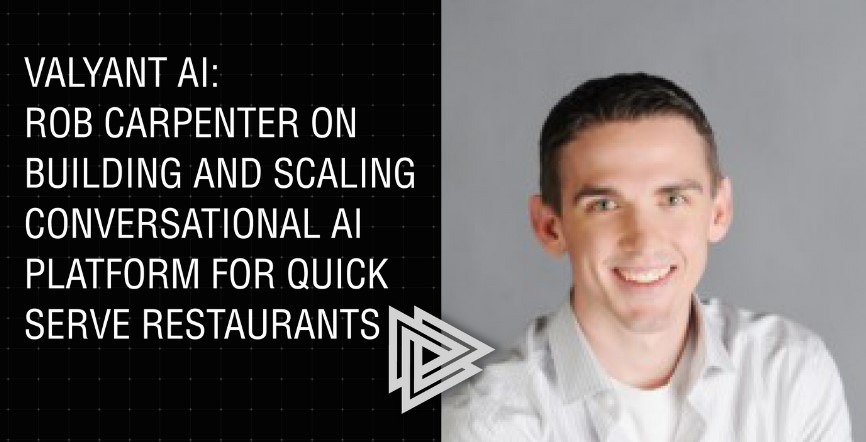
Rob Carpenter is the CEO and Founder of Valyant AI, an enterprise grade conversational AI platform for the quick serve restaurant industry. Valyant has developed a proprietary software application that integrates within a restaurant’s existing hardware infrastructure and allows the AI software to take the vast majority of customer orders and insert them directly into the POS for payment.
Prior to founding Valyant AI, Rob was the CEO of AppIt Ventures, a custom software development company with offices in Denver, Hyderabad and London. Over the first six years in business, AppIt built and launched over 350 custom software applications, including mobile apps on all major platforms, backend web applications and sophisticated databases.
Rob has a master’s degree in Business Administration with a specialization in Enterprise Technology Management. He spent two years on the board for the Rutt Bridges Venture Capital Fund. In 2013 Rob was named one of the top 25 most influential young professionals in Colorado by ColoradoBiz Magazine and in 2016 he received the Denver Trailblazer award.
Rob’s entrepreneurship journey began when he was young, after being introduced to Robert Kiyosaki’s book “Rich Dad, Poor Dad” which opened up new ways of thinking for him. He realized that there are so many possibilities in life beyond earning a degree, getting a job, clocking in, clocking out, getting a pension and retiring. When in fact, we all can take control of our lives and embark on projects and work that we are passionate about. Although a chaotic journey at times for Rob, this realization paved the way for an exciting and rewarding journey into entrepreneurship.
Initially Rob started a custom software development company where he built mobile applications for other people. Whenever he met and talked to other entrepreneurs, especially people that wanted to build companies, he highly recommends they start service based businesses. Service based businesses are more easy to get off the ground and are labor intensive. And if you work really hard, you can beat out your competition. Rob explains that through this path you can carve out a nice lifestyle business for yourself.
However, what a lot of people discover in about three to six years starting a service-based business is that even though it is quicker to start, they’re on a treadmill, constantly running. There is a constant turnover process of your customers. And at the end of the day, it’s exhausting. Rob soon decided he wanted to transition into a product-based company. While harder to get off the ground, once it’s up and running they tend to be more lucrative. A product-based business became easier to run for Rob because the product was earning revenue for him. This revenue stream is constant and comes through when Rob sleeps and when he is on vacation. He does not have to be constantly selling. This new way of doing business is what ultimately led Rob to wanting to get into some sort of forward-facing future technology. Artificial Intelligence is what became his perfect middle ground.
Rob strongly believes that a lot of entrepreneurs get too focused on their first company needing to be the next Google, Uber, or Facebook. When in fact, that’s not true. A bunch of studies have shown that the number one predictor of being able to start a billion-dollar company is having previously started another company and having had some sort of an exit. It’s important for people not to feel like they must shoot to the moon right out of the gate. Rob started a nice business, built his network and connections, and they launched Valyant after.
Developing the Technology and Finding the Product-Market Fit
Rob’s initial idea was to build AI employees for physical retail locations that have a physical presence. Basically, what we refer to as holograms. Rob and his team used a transparent OLED display to render the first version of this AI employee, integrating with this cutting edge and cool visual interaction with a holographic employee. However, the actual voice interaction was terrible. This was in 2017, and Valyant realized that the off the shelf technology worked for something simple, such as Alexa to turn off your lights. But it didn’t work for carrying on a fluid conversation like you might have with an employee. From here, Valyant had to pivot the business and focus on building an enterprise grade conversational AI platform. Rob realized that if they are going to make this holographic employee ever work, voice AI would have to work first.
The first customer that Valyant onboarded to their technology was called “Good Times”, it was a burger restaurant out in Denver, Colorado. The restaurant is a double drive through, with lanes on either side of the building. After a year and half, this was the first time a restaurant was willing to pilot with Valyant’s technology. At that time, the labor shortage in hospitality was already up to about 800,000 vacant positions. The product officially launched in October 2018, and Valyant was the first company to get this technology into market. Since then, Rob and his team have been continuing to grind and refine, iterate, and improve since then. Now the company is at a point where the technology is starting to propagate into the market. These are very exciting times for Valyant.
There have been hundreds, if not thousands of challenges related to trying to launch this type of technology, starting with the physical on-premises sort of hardware challenges. For example, there is no way to get audio off premise. So Valyant had to build their own hardware. They also faced AI challenges such as speech to text. There were massive amounts of work that must be done to get this technology to function properly. The NLP systems that were tested were not fast or responsive enough or able to handle multiple intents. Valyant had to build one from scratch.
Along with a plethora of additional challenges, Valyant had to learn how to package both the physical and digital human psychology all into a package that can respond back to the customer in a drive through in two seconds. This has been a tough problem for the company to solve.
Valyant has 22 people, with eight positions currently available. Valyant is looking to have about 30 employees by next month. Valyant is looking for talented engineers, or people that are really excited about the world of AI and want to get into the Artificial Intelligence space. By the end of the year, Valyant is expected to grow to about 50 employees.
In about five years, Valyant is looking to have about 10,000 restaurants running their voice AI technology. They are hoping to have digital holographic employees live in a couple of different industries, acquiring a few additional voice AI companies along the way. Valyant will also be looking for opportunities in new markets. As of right now, Rob and his team are hyper focused on delivering a fantastic product to the quick serve restaurant industry.
Rob’s Advice on Finding your First Customer
Make sure you always start with a problem first before you raise money and before you hire engineers. Gain an understanding of AI’s capabilities. Go out into the market and segment the market and talk to people in each of the different segments. Really sit down and brainstorm on where you think your technology can work. Once you identified a market, and you believe you identified a problem that your AI could solve, then work hard – either through networking, or through cold calls to meet people in that industry. Run your idea past them.
When you’re at the idea phase, ideas are a dime a dozen. There is nothing wrong with throwing your ideas against the real world and seeing what sticks and what doesn’t stick. Once you identify who the potential market is, that is when you can start to build the product and pre-sell to companies. If the problem you’re solving is big enough, companies should be willing to invest some money upfront to be able to get access to your solution. This would be the best-case scenario for selling your product and finding a market opportunity fit.

About the Host
Ari Yacobi is a data scientist, a teacher and a storyteller who has spent his career at…Read the Bio
